
08/18/2026 – For years, one of the most common pieces of advice in the Microsoft partner ecosystem has been simple:
Build relationships.
Meet more Microsoft sellers.
Get connected.
Expand your network.
And to be fair, that advice worked.
Many successful Microsoft partners built thriving businesses through strong
personal relationships, trusted connections, and years of credibility with
Microsoft teams.
But I believe we’re entering a new era of partner growth.
One where relationships still matter.
But no longer carry the weight they once did.
The Shift Most Partners Haven’t Recognized
Most partners still view Microsoft engagement as a relationship challenge.
Increasingly, it isn’t.
It’s an operational challenge.
Microsoft’s ecosystem has become larger, more specialized, and more complex
than at any point in its history.
There are more:
- Sellers
- Partner types
- Solution plays
- Incentive programs
- Marketplace motions
- Customer priorities
No individual can effectively navigate all of it.
And no Microsoft employee can maintain deep knowledge of every partner they encounter.
Relationships still create opportunities.
They no longer guarantee momentum.
When Relationships Stop Being Enough
Twenty years ago, a well-connected partner leader could significantly influence the growth trajectory of a company.
A few key relationships often opened most of the doors that mattered.
Today’s environment is different.
Growth increasingly depends on whether a partner can consistently create value across a much broader ecosystem.
Microsoft isn’t looking for partners it merely knows.
It’s looking for partners it can effectively engage, position, and scale.
That distinction matters.
Because many partners continue investing heavily in relationships while underinvesting in the systems required to capitalize on those relationships.
The Difference Between Connected and Scalable
We’ve observed a pattern repeatedly across the Microsoft partner ecosystem.
Some firms have extensive Microsoft networks.
They know the right people.
They attend the right events.
They have executive access.
They’ve built credibility over many years.
Yet growth remains inconsistent.
At the same time, other partners with significantly fewer relationships continue gaining visibility, engagement, and revenue.
Why?
Because they have built repeatable operating models.
Their value proposition is clear.
Their offerings align with Microsoft’s priorities.
Their customer outcomes are easy to explain.
Their sales, marketing, alliance, and delivery teams tell the same story.
Microsoft understands where they fit.
Customers understand why they matter.
The relationship creates awareness.
The operating model creates growth.
The Question Every Partner Should Be Asking
Many partners ask:
“How do we get more introductions inside Microsoft?”
That may no longer be the most important question.
A better question might be:
“What happens after we get them?”
If your growth depends on a handful of people maintaining key Microsoft relationships, you may not have a relationship advantage.
You may have a dependency.
And dependencies rarely scale.
What High-Growth Partners Are Doing Differently
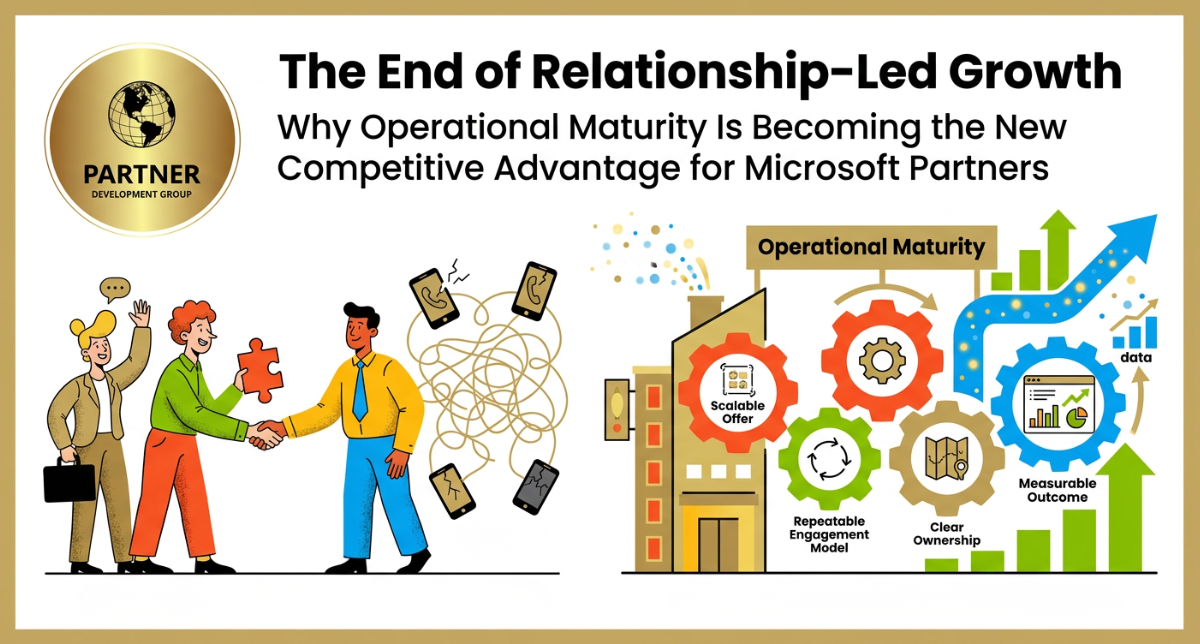
The highest-performing partner organizations intentionally reduce reliance on individual relationships by building:
- Repeatable Microsoft engagement motions
- Clearly defined ownership and accountability
- Consistent customer outcome stories
- Scalable offers and services
- Measurable business objectives
- Operational processes that survive personnel changes
In other words, they create systems that support relationships rather than systems that depend on them.
The Hidden Risk Lurking Inside Many Partner Organizations
Relationships can mask underlying weaknesses.
As long as opportunities continue flowing through trusted connections, organizations often fail to recognize where operational gaps exist.
Then a key contact changes roles.
A reorganization occurs.
A territory shifts.
A seller moves to another team.
And suddenly growth slows.
Not because the partner became less capable.
But because too much of the business was concentrated in individual relationships.
The strongest partner organizations are resilient to those changes.
Their growth engine continues running because it was never dependent on a single person in the first place.
What the Next Generation of Microsoft Partners Will Look Like
The partners that thrive over the next decade won’t necessarily be the ones with the largest networks.
They’ll be the ones with the strongest operating models.
The firms that win will be able to answer questions such as:
- How do we align to Microsoft’s priorities?
- How do we engage consistently across teams and geographies?
- How do we make our value easy to understand?
- How do we turn introductions into repeatable outcomes?
- How do we scale beyond the strength of individual relationships?
Those capabilities are becoming competitive advantages.
And unlike relationships, they can be institutionalized.
Relationships Are Becoming the Door Opener, Not the Growth Engine
None of this means relationships are losing their importance.
Trust matters.
Reputation matters.
People will always do business with people.
That isn’t changing.
What is changing is the role relationships play in partner growth.
Relationships are increasingly becoming the door opener.
Not the growth engine.
The growth engine is everything that happens after the introduction.
The strategy.
The alignment.
The execution.
The accountability.
The operational maturity.
Because as Microsoft’s ecosystem continues to grow, scale will become more valuable than connectivity.
And that may be one of the most important shifts unfolding in today’s partner community.
Final Thought
Relationships might get your company invited into the conversation.
Operational maturity determines whether you keep getting invited back.