
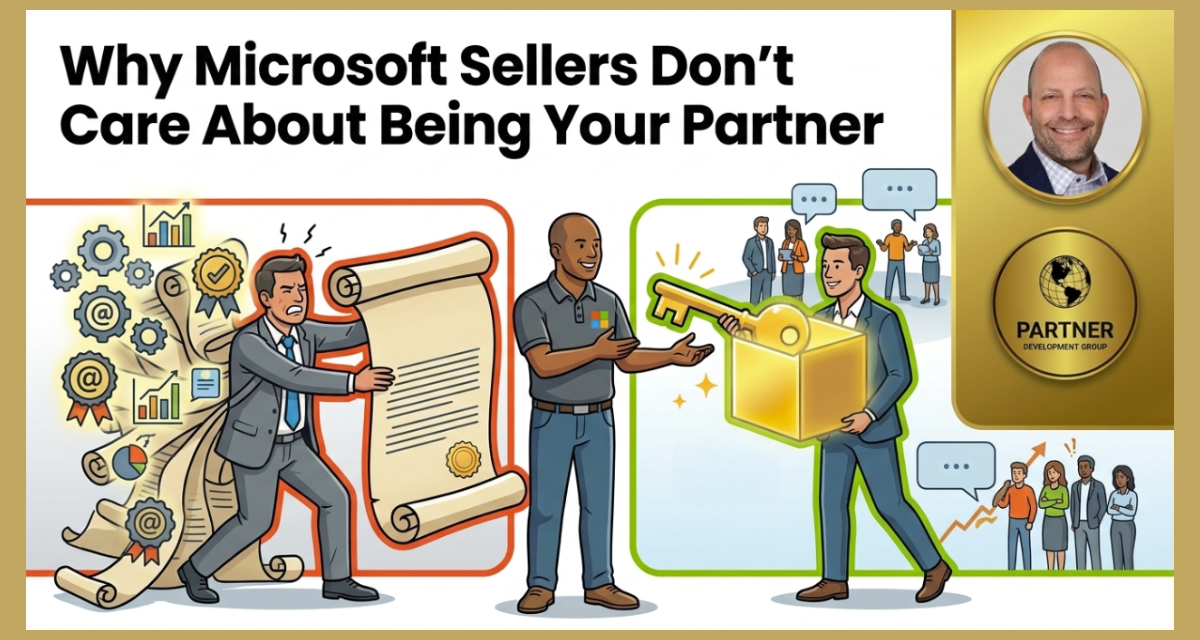
They attend events, pursue designations, schedule seller meetings, and invest heavily in co-sell readiness.
None of that is wrong.
But it often starts with a dangerous assumption.
That Microsoft sellers are looking for partners.
They’re not.
The Assumption
When partners think about building a Microsoft practice, they often focus on strengthening their Microsoft relationship. The objective seems logical: become a better partner, become more visible to Microsoft, and more opportunities will follow.
Unfortunately, that’s not how most sellers think.
Microsoft sellers don’t wake up in the morning asking themselves:
“How can I help my partners today?”
They’re focused on something else entirely.
The Seller’s Reality
Every seller operates within a world of customers, opportunities, forecasts, commitments, and revenue targets. Their success is measured by their ability to help customers move forward while achieving business outcomes for Microsoft.
That creates a very different perspective than most partners expect.
A seller is constantly evaluating questions such as:
- How do I help this customer succeed?
- How do I accelerate this opportunity?
- How do I reduce risk?
- How do I improve the likelihood of closing business?
Partners enter the conversation only when they help answer those questions.
That’s an important distinction.
Partnership Is Not the Goal
This is where many partner conversations go off track.
Partners often approach Microsoft sellers hoping to establish a partnership. They lead with company overviews, certifications, service catalogs, and discussions about their Microsoft investment.
Meanwhile, the seller is trying to determine something much simpler:
“How can this partner help me and my customer?”
The strongest partners understand that partnership is not the starting point.
Partnership is the outcome.
What Sellers Actually Care About
Microsoft sellers care deeply about partners.
They just care about them for different reasons than many partners assume.
The partners that earn attention are often the ones that make a seller’s life easier.
They help:
- Solve customer problems
- Accelerate customer outcomes
- Reduce delivery risk
- Support Microsoft priorities
- Create successful references
Those things create value.
And value creates engagement.
A Common Mistake
I’ve seen capable partners spend an entire Microsoft meeting explaining who they are.
Their history.
Their certifications.
Their capabilities.
Their services.
Their awards.
At the end of the conversation, the seller understands the partner better.
But they still don’t know when to use them.
That’s a problem.
Knowing who you are is not the same as knowing why you matter.
The Partners Sellers Remember
The partners that consistently gain traction tend to communicate differently.
They don’t start with themselves.
They start with customer challenges.
They explain the problems they solve, the outcomes they create, and the situations where they deliver the most value. They make it easy for a seller to connect their capabilities to real customer conversations.
The seller leaves knowing exactly where the partner fits.
That’s what matters.
The Shift
The most successful partners eventually make a mental shift.
Instead of asking:
“How do we become a stronger Microsoft partner?”
They start asking:
“How do we become more valuable to Microsoft sellers and customers?”
Those questions sound similar.
They’re actually very different.
One focuses on the relationship.
The other focuses on the outcome.
The Bigger Lesson
Microsoft sellers are not searching for partners.
They’re searching for solutions to customer problems.
The partners who understand this stop chasing partnership for its own sake. Instead, they focus on becoming relevant, useful, predictable, and easy to engage.
Ironically, that’s when the strongest partnerships often begin to form.
The question isn’t:
“How do we get Microsoft to view us as a partner?”
The better question is:
“What would make a Microsoft seller genuinely want us involved in an important customer opportunity?”
Partners that answer that question well usually discover something interesting.
The partnership tends to take care of itself.