
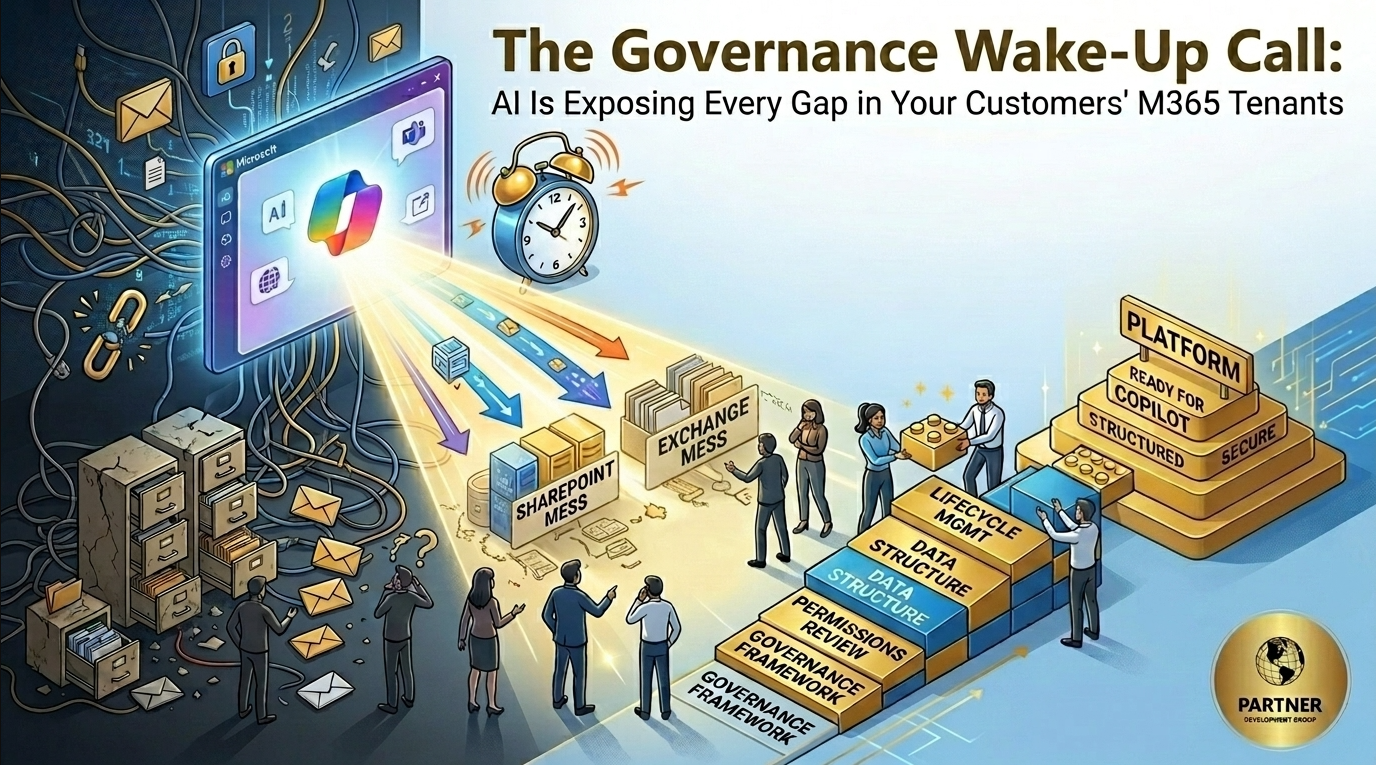
06-16-2026 – There’s a shift happening across the Microsoft ecosystem.
It’s not about new Copilot features. It’s not about which workloads are enabled first.
It’s about what Copilot reveals the moment it gets turned on.
For many customers, that realization hits fast.
What was once buried inside SharePoint sites, Teams channels, and email threads is now visible, searchable, and summarized in seconds.
Copilot isn’t just improving productivity.
It’s exposing the reality of the tenant.
Copilot Doesn’t Create Problems. It Surfaces Them.
For years, Microsoft 365 environments have accumulated:
- Duplicated and outdated content
- Inconsistent information architecture
- Over-permissioned sites and libraries
- Unclear data ownership and lifecycle
Those issues were manageable when users had to manually search, navigate, and interpret content.
Now, Copilot removes that friction.
It aggregates and surfaces information instantly, pulling from across SharePoint, Teams, OneDrive, and Exchange through Microsoft Graph.
If the underlying environment is clean and structured, the output is valuable.
If it’s not, the output reflects that.
And in some cases, it amplifies it.
Governance gaps are no longer hidden operational issues. They are now user-facing outcomes.
AI Changes the Stakes
Traditional governance challenges used to be about organization and control.
AI changes the stakes entirely.
A single Copilot query can:
- Pull data from multiple systems simultaneously
- Synthesize information across sources
- Present answers in a new context the user didn’t explicitly navigate to
This introduces a fundamentally different risk model.
In Power Platform and Copilot Studio scenarios, agents can go even further. They can access multiple data sources, trigger workflows, and act autonomously based on context and inputs.
The issue isn’t just “who has access to what.”
It’s how quickly and broadly that access can be activated, combined, and surfaced.
Why Customers Are Stalling at Pilot
This is why so many organizations are pausing after initial Copilot rollouts.
Not because they don’t see the value.
But because they’re realizing what’s required to scale it.
Across enterprises, the pattern is consistent:
- Controlled pilots with limited users
- Focus on specific use cases
- Evaluation of data readiness and governance gaps
- Delay of broader rollout until those issues are addressed
Many organizations are still in pilot stages precisely because they are validating readiness, outcomes, and risk before scaling further.
This is the governance moment.
Governance Has Moved to the Front of the Conversation
Historically, governance was treated as a back-end function.
Something handled after deployment. Something required for compliance.
That model doesn’t work in the AI era.
Because Copilot is not a standalone tool.
It is a layer across the entire Microsoft 365 environment.
Which means:
Every flaw in the foundation becomes visible the moment AI is applied.
Customers are starting to ask different questions:
- What will Copilot actually see across our tenant?
- What content is exposed today that shouldn’t be?
- How do permissions and data classification impact outputs?
- What needs to change before we scale beyond pilot?
These are not technical questions.
They are strategic ones.
The Partner Opportunity Is Changing
This is where the opportunity shifts for Microsoft partners.
The conversation is moving away from:
- Licensing
- Feature enablement
- Basic deployment services
And moving toward AI Readiness and Tenant Transformation
The partners who lead with Copilot enablement alone will struggle to deliver outcomes.
The partners who lead with:
- Tenant assessment and cleanup
- Data governance and Purview alignment
- Information architecture redesign
- Controlled rollout strategies tied to use cases
Will own the relationship.
Because that’s what customers actually need to move forward.
Governance Is Now the Growth Engine
This is the key shift.
Governance is no longer a blocker to innovation.
It is the enabler of AI at scale.
Without it:
- Copilot outputs are inconsistent
- Risk exposure increases
- Adoption stalls
With it:
- Outputs become more relevant and trusted
- AI use cases expand across the business
- Customers move from pilot to production
The difference is not the technology.
It’s the foundation.
The Bottom Line
AI is not breaking your customers’ environments.
It’s revealing them.
The organizations that succeed with Copilot will not be the ones who move the fastest.
They will be the ones who fix what’s underneath before they scale what’s on top.
And the partners who understand that shift will be the ones who lead the next phase of the Microsoft ecosystem.