
06/30/2026 –
Every July, Microsoft partners look for clues about where Microsoft is investing, how sellers will engage customers, and which motions will create the greatest opportunity in the year ahead.
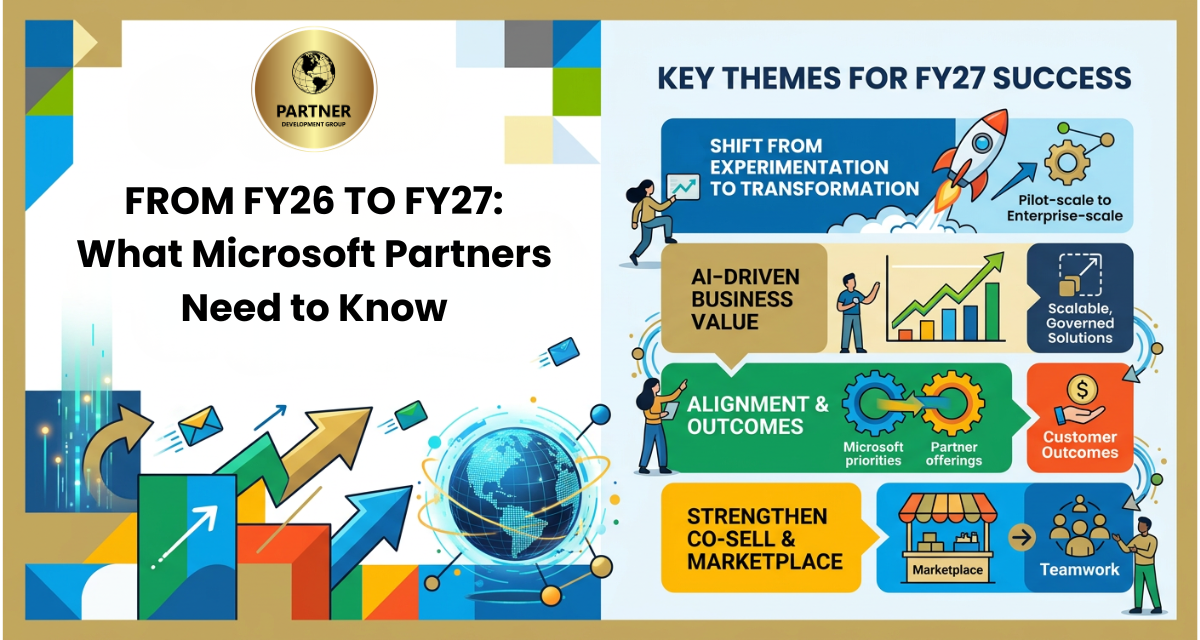
As FY27 begins, one thing is clear: Microsoft is doubling down on AI, security, cloud consumption, and marketplace-led growth. While many of these themes existed in FY26, the emphasis in FY27 is noticeably different. The focus has shifted from introducing AI to scaling AI. From experimentation to execution. From technical possibility to measurable business outcomes.
For Microsoft partners, that shift has important implications.
AI Has Moved from Opportunity to Expectation
Throughout FY26, many organizations were still evaluating AI strategies, testing Copilot deployments, and running pilot projects. In FY27, Microsoft’s messaging suggests that the market is entering a new phase where customers are expected to move beyond experimentation and begin operationalizing AI across the business.
This creates a significant opportunity for partners, but it also raises the bar.
Customers are no longer looking only for implementation assistance. They need partners who can help them:
- Identify business use cases
- Prepare and govern their data
- Secure AI deployments
- Measure outcomes
- Develop and manage agents
- Drive adoption across the organization
The partners that succeed in FY27 will be those that can connect technology decisions directly to business results.
Microsoft Is Investing in “Frontier Transformation”
A recurring theme in Microsoft’s FY27 partner communications is “Frontier Transformation,” Microsoft’s vision for helping organizations achieve meaningful business transformation through AI, cloud, data, and security capabilities.
For partners, this means customer conversations should increasingly focus on:
- Business process transformation
- Operational efficiency
- Workforce productivity
- Data-driven decision making
- AI-enabled modernization
The conversation is becoming less about features and more about outcomes.
Partners that continue leading with products alone may find themselves at a disadvantage compared to partners that lead with business value and transformation services.
Marketplace Is Becoming a Strategic Requirement
Over the last several years, Microsoft has steadily elevated the importance of Microsoft Marketplace. FY27 appears to continue that trajectory. Microsoft’s public partner communications consistently highlight Marketplace alongside co-sell, Azure solution plays, and cloud growth initiatives.
For many partners, Marketplace can no longer be viewed as simply another marketing channel.
Instead, it is increasingly becoming:
- A procurement vehicle
- A co-sell enabler
- A route to seller engagement
- A mechanism for scaling transactions
Partners that have not yet developed transactable offers, private offer capabilities, or a Marketplace strategy should evaluate how Marketplace aligns with their broader go-to-market approach.
The Importance of Co-Sell Continues to Grow
Microsoft sellers remain focused on helping customers achieve measurable outcomes across AI, security, cloud, and business applications. As a result, partners that can clearly support those priorities have a greater opportunity to engage in meaningful co-sell motions.
The reality is that Microsoft field teams have limited time and countless partner options.
The partners that stand out typically have:
- Clear differentiation
- Repeatable customer success stories
- Well-defined solution plays
- Marketplace readiness
- Demonstrated customer impact
FY27 reinforces a trend that’s been developing for several years: visibility alone is not enough. Relevance and execution matter.
Security Is Becoming Part of Every Solution
Security remains one of Microsoft’s most strategic investment areas, and the emergence of AI is only increasing its importance. As customers deploy AI solutions, questions around governance, compliance, identity, data protection, and risk management become unavoidable.
This creates an opportunity for partners across virtually every practice area.
Whether your business focuses on:
- Modern Work
- Azure
- Dynamics 365
- Data & Analytics
- AI
- Managed Services
Security increasingly becomes part of the conversation.
The most successful partners will be those that can position security as an integrated component of transformation rather than a separate workstream.
Customer Outcomes Are the New Currency
Perhaps the most important shift entering FY27 is Microsoft’s continued focus on customer outcomes.
Partners should expect ongoing attention around:
- Adoption
- Consumption
- Business value
- ROI
- Customer success
The days of generic capability statements and broad service descriptions are fading. Customers and Microsoft alike are looking for evidence that a solution produces measurable results.
Partners that can demonstrate outcomes through case studies, metrics, references, and repeatable methodologies will be better positioned to capture opportunity.
Five Questions Every Partner Should Ask Going Into FY27
As the new fiscal year begins, partner leaders should consider the following:
1. Is Our AI Story Clear?
Can prospects and Microsoft sellers quickly understand how your organization helps customers adopt and scale AI?
2. Are We Marketplace Ready?
Can customers easily discover, transact, and engage with your offerings through Microsoft Marketplace?
3. Are We Aligned to Microsoft’s Priorities?
Does your messaging align with Microsoft’s investments in AI, cloud, security, and business transformation?
4. Can We Demonstrate Outcomes?
Do you have the customer stories, metrics, and proof points needed to support Microsoft’s customer success objectives?
5. Are We Prepared for Scale?
If Microsoft introduced your organization to several qualified opportunities tomorrow, could your business deliver successfully and repeatedly?
Final Thoughts
FY27 does not feel like a year of incremental change.
Microsoft is signaling that the future belongs to partners that can help customers move beyond pilots and proofs of concept into scalable, secure, and measurable business transformation. AI remains the headline, but the story is much bigger than AI alone. Marketplace execution, security, co-sell readiness, cloud consumption, and customer outcomes are becoming increasingly interconnected.
For partners, the opportunity is substantial.
But success in FY27 will likely belong to those who align their business strategy, offerings, and investments with where Microsoft is going next, not where it has already been.
The partners that thrive in FY27 won’t simply follow Microsoft’s priorities. They’ll operationalize them.