
07/08/2026 –
Most Microsoft partners spend far too much time trying to build a co-sell motion.
The most successful partners spend almost no time thinking about co-sell itself.
That sounds backwards.
But after years of working with Microsoft partners, I’ve noticed a pattern.
The partners that struggle with co-sell tend to view it as a destination.
The partners that succeed view it as a byproduct.
A byproduct of strategic alignment, strong offers, customer outcomes, and seller trust. Microsoft positions co-sell as a collaborative engagement between partners and Microsoft sellers to solve customer needs, not simply a programmatic status or designation.
The Misunderstanding
Many partners ask:
“How do we get more co-sell opportunities?”
It feels like the right question.
Usually, it’s the wrong one.
Because co-sell does not create relevance.
Relevance creates co-sell.
Microsoft sellers are not looking for partners that have activated a process.
They’re looking for partners who make it easier to win business, drive adoption, and deliver successful customer outcomes. Partners who align with seller priorities and help achieve Microsoft’s strategic objectives are more likely to gain advocacy and engagement.
What Happens Before Co-Sell Matters More
Long before a Microsoft seller introduces a partner into an opportunity, they are evaluating signals.
Is the offer easy to understand?
Does it align with Microsoft’s priorities?
Can it be explained in a customer conversation without translation?
Is there evidence it works?
Can the partner be trusted to execute?
Most partners focus on getting “co-sell ready.”
The stronger partners focus on becoming “seller relevant.”
That’s a very different objective. The strongest partners become a solution to seller challenges rather than simply requesting referrals or assistance.
What Happens After Co-Sell Matters Even More
This is the part almost nobody talks about.
The first opportunity is rarely the most important one.
The second, fifth, and tenth opportunities are.
Microsoft sellers build trust through experience.
Every successful engagement creates confidence.
Every failed engagement creates hesitation.
Remember, it’s an algorithm.
When a partner consistently delivers strong customer outcomes, communicates effectively, and makes sellers look good, trust compounds.
Eventually, the conversation changes.
Instead of asking:
“Can this partner help?”
Sellers begin asking:
“Why wouldn’t we bring them in?”
That is where real ecosystem growth begins.
The Real Purpose of Co-Sell
Co-sell is not a growth strategy.
It is a validation signal.
It is the result of doing many other things well.
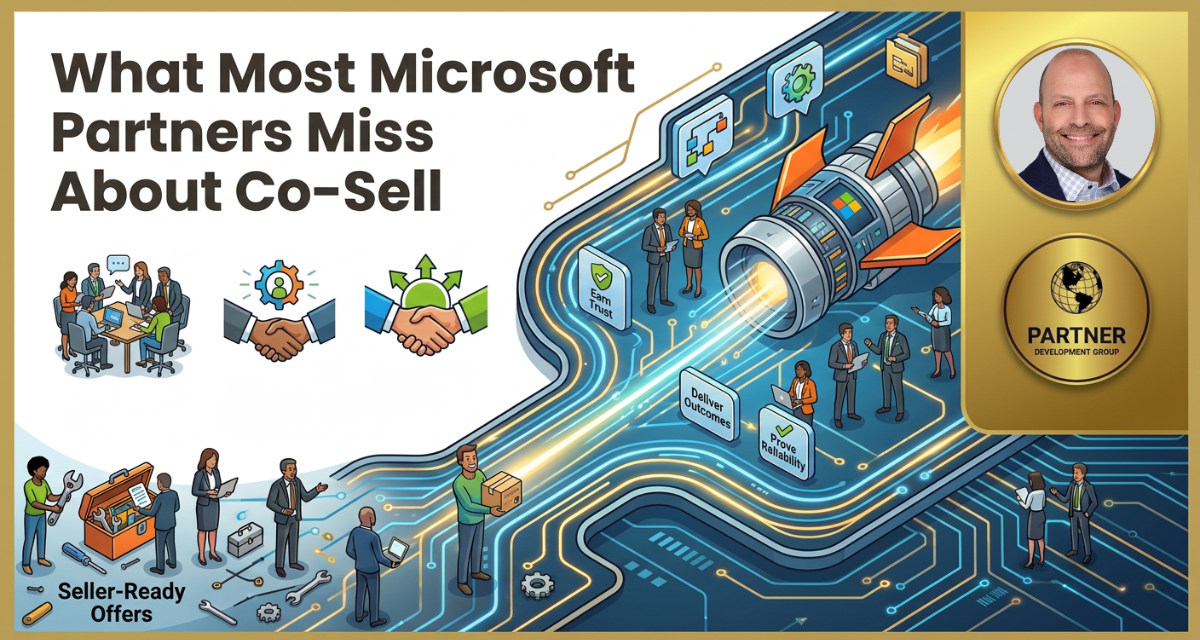
The partners that win consistently understand that co-sell sits in the middle of the journey, not at the beginning.
Everything before it earns trust.
Everything after it compounds trust.
And trust is ultimately what drives influence inside the Microsoft ecosystem.
Final Thought
The question isn’t:
“How do we build a co-sell motion?”
The better question is:
“What would have to be true for a Microsoft seller to confidently bring us into an important customer conversation?”
Answer that well, and the co-sell motion largely takes care of itself.