
07/29/2026 – Many Microsoft partners spend years building certifications, designations, specializations, and technical credentials.
Then they’re surprised when Microsoft sellers don’t seem particularly impressed.
At first, that feels unfair.
After all, earning those credentials takes significant investment. Partners commit substantial time, money, and resources to building the expertise Microsoft expects from a trusted ecosystem partner.
So why don’t certifications create more seller engagement?
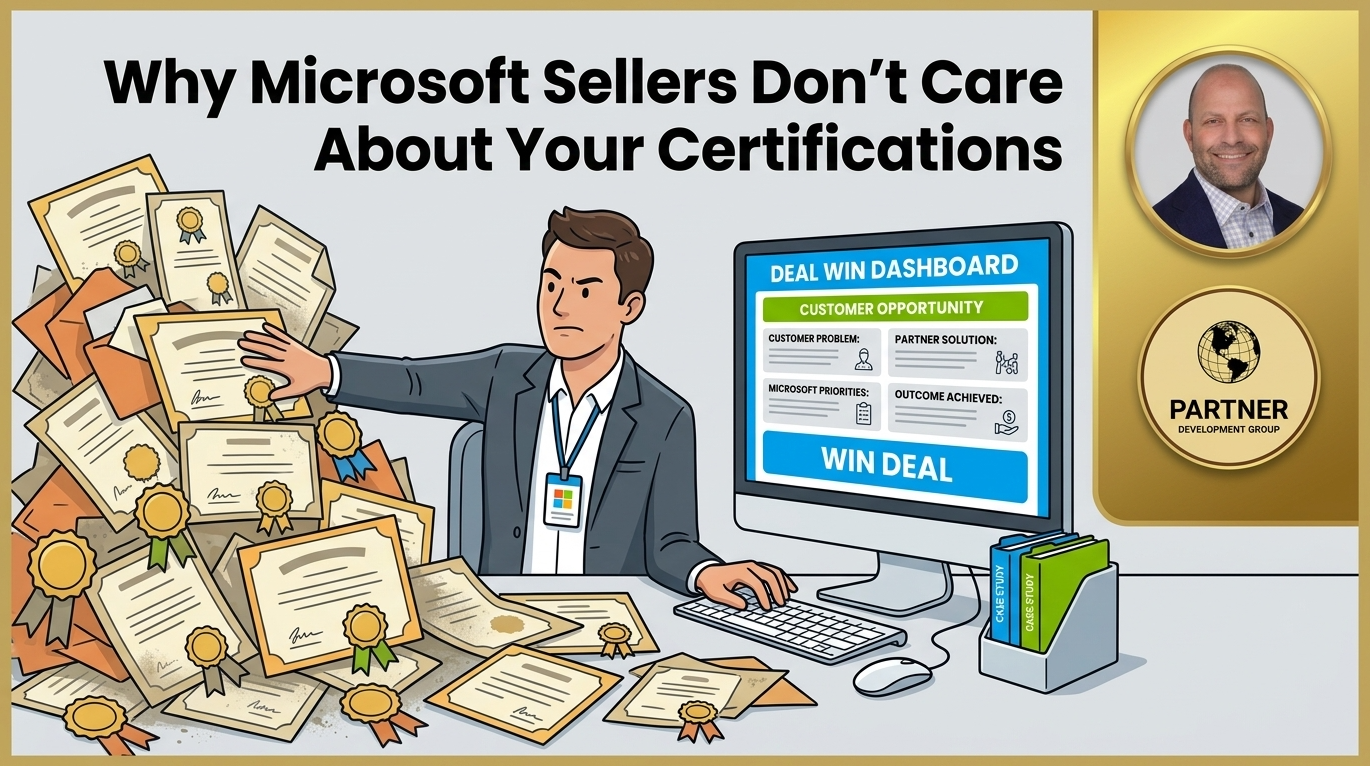
Because Microsoft sellers are not looking for the most certified partner.
They’re looking for the partner most likely to help them win.
The Assumption
I’ve spoken with many partners who believe their certification portfolio should create more opportunities.
The thinking usually goes something like this:
“We achieved the designation.”
“We earned the specialization.”
“We invested in the training.”
“So why aren’t Microsoft sellers engaging with us?”
It’s a reasonable question. But it assumes sellers evaluate partners the same way Microsoft evaluates partners.
They don’t.
Microsoft and Microsoft Sellers Are Solving Different Problems
Microsoft’s partner programs exist to establish capability.
Certifications, designations, and specializations help demonstrate that a partner possesses the technical knowledge and organizational maturity required to deliver solutions successfully.
Those signals matter. They’re valuable, and they’re often necessary.
But a Microsoft seller is evaluating something different.
A seller is not asking:
“Can this partner deliver?”
They’re asking:
“Should I bring this partner into this opportunity?”
The difference is subtle.
But it’s important.
What Sellers Actually Care About
Imagine two partners.
The first has every relevant certification, multiple designations, and an impressive collection of Microsoft badges.
The second has fewer credentials but a very clear story around a specific customer challenge.
That second partner can explain:
- The problem they solve
- The customers they help
- The business outcomes they create
- The Microsoft priorities they support
- The results they’ve delivered
Which partner gets introduced into the opportunity?
Often, it’s the second one.
Not because certifications don’t matter.
Because relevance matters more.
Certifications Establish Credibility
Relevance Creates Engagement
This is the distinction many partners miss.
Certifications help a seller believe you are capable.
Positioning helps a seller understand why you belong in the conversation.
Those are not the same thing.
A customer rarely buys a solution because a partner has a specific certification.
Customers buy outcomes.
Sellers know this.
That’s why they spend less time evaluating credentials and more time evaluating fit.
The Credential Trap
Sometimes certifications can unintentionally create complacency.
Partners invest heavily in technical validation and assume that validation will naturally lead to seller advocacy.
Then months pass.
The certifications are earned.
The designations are achieved.
The Marketplace listing is complete.
Yet co-sell activity remains limited.
The reason is simple.
The certifications solved a Microsoft requirement.
They didn’t solve a seller requirement.
A seller still needs to answer questions like:
- Why should this partner be involved?
- What customer problem do they solve?
- How do they help me win?
- What makes them different?
- Why should I trust them in front of my customer?
No certification answers those questions.
Where Certifications Actually Matter
This isn’t an argument against certifications.
In fact, strong certifications often become the deciding factor once relevance has already been established.
Think of certifications as proof.
Not positioning.
They help validate the story.
They do not create the story.
The strongest partners typically combine both.
They have the technical credibility to deliver.
And they have the market clarity to be easily understood.
That’s a powerful combination.
The Bigger Lesson
Most Microsoft partners spend considerable energy becoming qualified.
Fewer spend the same amount of energy becoming memorable.
Yet sellers rarely advocate for partners they merely recognize.
They advocate for partners they understand.
The partners that consistently earn engagement aren’t necessarily the ones with the most certifications.
They’re the ones that make it easiest for sellers to answer a very simple question:
“Why would I bring this partner into this customer conversation?”
When that answer is obvious, certifications become an accelerator.
When that answer is unclear, certifications become background noise.
And that may be one of the most misunderstood realities in the Microsoft partner ecosystem.